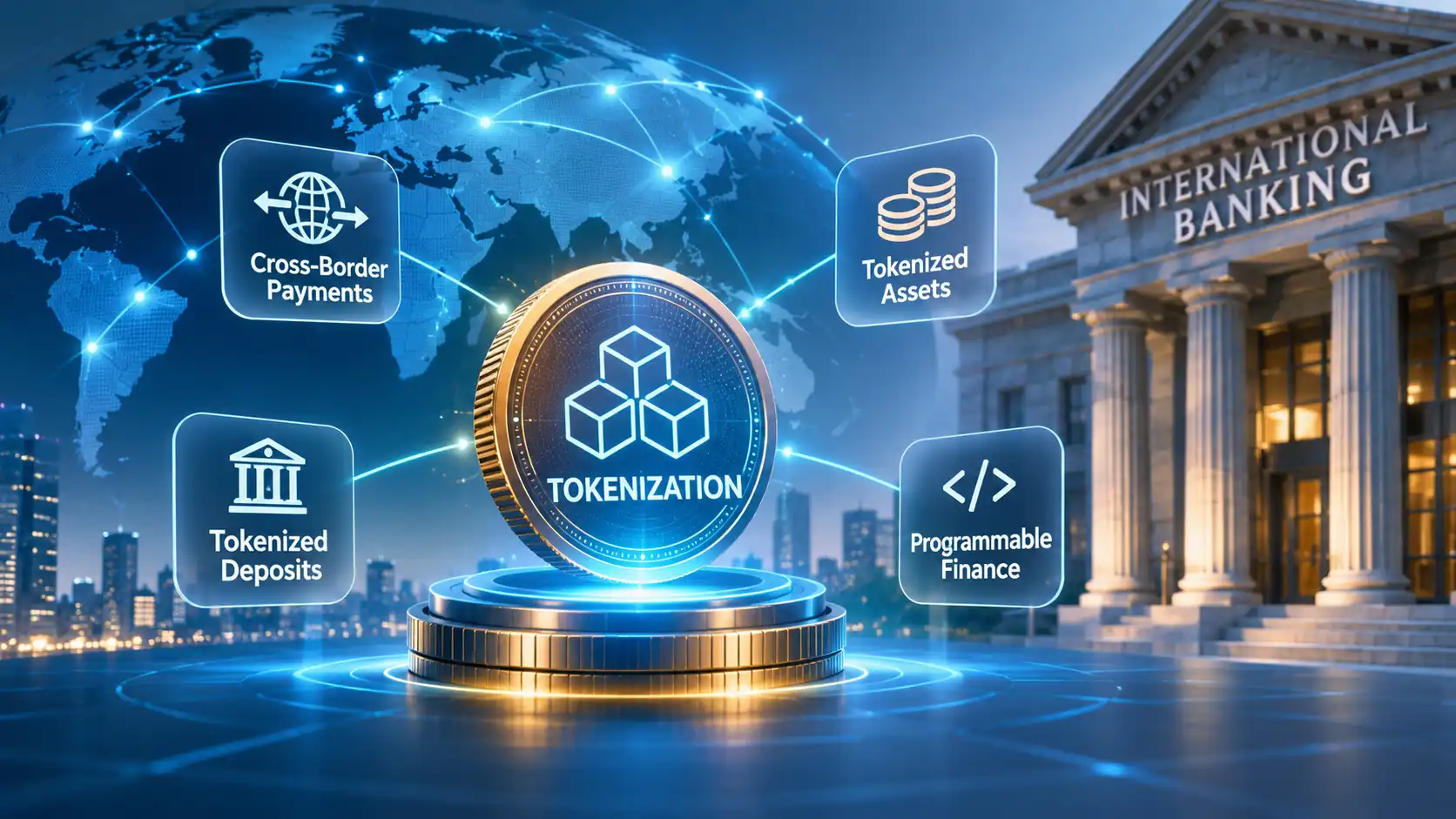
Introduction
International banking is entering a period of potentially profound technological change.
For decades, banks have relied on a combination of account-based ledgers, payment messaging networks, correspondent banking relationships and financial market infrastructures to move money and settle transactions across borders.
These systems support enormous volumes of financial activity, but they are not always seamless.
A payment between two countries may involve multiple financial institutions, separate messaging systems, different operating hours and several reconciliation processes.
Similarly, the transfer of financial securities can involve intermediaries responsible for trading, clearing, custody and settlement.
Tokenization offers a different approach.
By representing money, financial claims and other assets on programmable digital platforms, tokenization could allow several stages of a transaction to be coordinated more closely.
This may reduce operational complexity, improve transparency and enable new forms of financial services.
However, the technology also raises fundamental questions.
Who owns the underlying asset? Which institution guarantees redemption? When does settlement become legally final? What happens if a shared platform fails? And how should regulators supervise financial activities conducted through programmable infrastructure?
These questions matter because international banking is built on more than technology.
It depends on legal certainty, trusted institutions, reliable settlement assets and the ability to manage financial risk across jurisdictions.
The Bank for International Settlements (BIS) has identified tokenization as a potentially transformative development for the next generation of the monetary and financial system.
Yet the long-term significance of tokenization will depend less on the creation of digital tokens themselves and more on whether banks can integrate them into secure, interoperable and legally enforceable financial arrangements.
Tokenization is not simply about making money digital. It is about changing how financial ownership, transactions and settlement are organized.
1. What Is Tokenization in Banking?
Tokenization is the process of representing an asset, claim or financial entitlement through a digital token recorded on a programmable ledger or similar digital infrastructure.
The underlying asset may be money held at a commercial bank, a government bond, a corporate security or another financial instrument.
A token may contain or reference information about ownership, transfer rights and the conditions under which a transaction can occur.
For example, a bank could issue a digital representation of a customer's deposit claim.
Instead of relying exclusively on conventional account-entry processes, the bank could use an authorized digital platform to record and transfer that claim.
Similarly, a government bond could be represented through a token whose ownership and transfer are recorded electronically.
The critical point is that a token is not automatically a separate asset from the underlying financial claim.
Its legal and economic characteristics depend on how the arrangement is structured.
Tokenization Versus Ordinary Digital Banking
Bank deposits are already digital in most modern banking systems.
Customers can view balances, transfer money and make payments electronically.
Tokenization does not create digital money for the first time.
Its potential innovation lies in integrating financial records, transfer instructions and programmable transaction conditions within a common technological environment.
Traditional financial systems frequently maintain separate records across multiple institutions.
Tokenized systems may allow authorized participants to operate with synchronized records and execute coordinated transactions.
This can reduce the need for repeated reconciliation between different databases.
However, merely recording an asset on a blockchain does not automatically improve efficiency or create legally enforceable ownership.
The benefits depend on the platform design, governance, underlying rights and integration with existing financial systems.
2. How Tokenization Could Change International Banking
International banking involves interactions among financial institutions operating under different currencies, legal systems and regulatory frameworks.
This creates substantial coordination requirements.
A typical international payment may involve the originating bank, one or more correspondent banks, foreign exchange arrangements and the beneficiary's bank.
Each institution may maintain its own records and compliance procedures.
Tokenization could allow selected elements of these processes to be coordinated on shared programmable infrastructure.
Potential improvements include:
- Faster reconciliation between participating financial institutions.
- More transparent transaction status and processing.
- Coordinated transfer of money and financial assets.
- Automated execution of predefined contractual conditions.
- Better visibility of payment and settlement obligations.
- Reduced dependence on some sequential operational processes.
These improvements are possibilities rather than guaranteed outcomes.
Cross-border payments still require liquidity, foreign exchange conversion, sanctions screening, fraud controls and legal compliance.
Tokenization does not eliminate those responsibilities.
Instead, it may change how financial institutions coordinate and perform them.
3. Tokenized Deposits: Connecting Innovation With Commercial Banking
One of the most important developments is the emergence of tokenized commercial bank deposits.
A tokenized deposit represents a claim on a commercial bank that is recorded and potentially transferred using token-based infrastructure.
The bank remains responsible for the deposit obligation under the relevant legal arrangements.
This distinguishes tokenized deposits from many privately issued digital assets.
How Tokenized Deposits Work
Consider a hypothetical multinational company holding $10 million in a commercial bank account.
The bank operates an authorized platform that supports tokenized deposits.
Under an appropriately designed arrangement, part of the company's deposit balance could be represented through transferable digital tokens.
These tokens might then be used for approved payments or settlement transactions within the participating network.
However, the transaction must preserve the legal rights associated with the deposit.
It must also ensure that balances cannot be duplicated, improperly transferred or redeemed more than once.
If transfers involve different banks, the institutions need a reliable mechanism for settling obligations between them.
This is particularly important because a deposit at Bank A represents a liability of Bank A, while a deposit at Bank B represents a liability of Bank B.
Even if both deposits are denominated in the same currency, their issuers are different.
A robust system must therefore ensure that transfers between banks preserve the integrity of money and settlement.
Why Tokenized Deposits Matter
Tokenized deposits could allow banks to modernize transaction processing while maintaining commercial bank money as an important means of payment.
Potential applications include wholesale payments, corporate treasury management, securities settlement and programmable financial transactions.
However, the precise legal treatment, transferability, deposit protection and redemption rights depend on the jurisdiction and product structure.
Not every token labeled a bank deposit should be assumed to receive identical protections.
4. Tokenized Deposits, Stablecoins and Central Bank Digital Currencies
Tokenized deposits are often confused with stablecoins and central bank digital currencies.
Although all three can involve digital representations of monetary value, they differ in important ways.
| Feature | Tokenized Bank Deposit | Stablecoin | Central Bank Digital Currency |
|---|---|---|---|
| Typical Issuer | Commercial bank | Authorized or other private issuer | Central bank |
| Nature of Claim | Claim on a bank, subject to structure | Claim or redemption right defined by the arrangement | Central bank money |
| Value Stability | Linked to the denominated bank deposit | Often designed to maintain a reference value | Denominated in sovereign currency |
| Regulatory Framework | Banking laws and applicable requirements | Stablecoin and other applicable financial regulations | Central bank and applicable monetary legislation |
| Typical Applications | Bank payments and settlement | Payments, digital asset transactions and transfers | Retail or wholesale central bank money |
| Main Considerations | Bank credit risk, legal rights and interoperability | Reserve quality, redemption and issuer risk | Design, access, privacy and monetary policy implications |
Tokenized Deposits
Tokenized bank deposits preserve a relationship with a regulated commercial bank and its deposit liabilities, subject to the legal design.
They can potentially operate within the existing two-tier monetary system in which central bank money supports settlement between commercial banks.
Stablecoins
Stablecoins are digital assets designed to maintain a relatively stable value against a reference asset, commonly a national currency.
Their stability depends on the issuer's reserve assets, redemption arrangements, governance and regulatory oversight.
Stablecoins are not automatically equivalent to insured commercial bank deposits.
Some can provide useful payment functionality, but their risk characteristics vary considerably.
Central Bank Digital Currencies
A central bank digital currency, or CBDC, is a digital form of central bank money.
Retail CBDCs are generally discussed in connection with payments by the public.
Wholesale CBDC arrangements focus on transactions among eligible financial institutions.
Tokenized central bank reserves can provide a particularly important settlement foundation for wholesale financial markets.
The BIS has emphasized that central bank money, commercial bank money and government securities could form an important combination within next-generation tokenized financial infrastructure.
5. Why Cross-Border Payments Are a Major Opportunity
Cross-border payments remain one of the most promising applications of financial tokenization.
International transfers often involve separate payment instructions, currency conversion, compliance checks and settlement processes.
The sequence can create delays and operational complexity.
Different countries may also have different banking hours and settlement arrangements.
Tokenization could help financial institutions coordinate these stages more efficiently.
An Illustrative International Payment
Consider a hypothetical company in Germany making a €2 million payment to a supplier in Japan.
Under a conventional correspondent banking arrangement, the payment could involve multiple banks and foreign exchange providers.
Each participant may process instructions and update internal records separately.
With an interoperable tokenized settlement platform, participating institutions could potentially coordinate the transfer of euro-denominated and yen-denominated value within a controlled transaction workflow.
The transfer could occur only when all required conditions are satisfied.
If one side of the transaction cannot settle, the arrangement may be designed to prevent the other side from completing independently.
This is an example of atomic settlement.
Understanding Atomic Settlement
Atomic settlement means that related transaction components complete together or do not complete at all.
For foreign exchange, this can support payment-versus-payment arrangements.
For securities transactions, it can support delivery-versus-payment arrangements.
In each case, the objective is to reduce the risk that one participant delivers value without receiving the corresponding payment or asset.
However, atomic settlement requires appropriately designed infrastructure, enforceable transaction rules and sufficient available liquidity.
A programmable ledger alone cannot guarantee those conditions.
6. Project Agorá: An Important International Banking Experiment
Project Agorá is among the most significant initiatives examining the future of tokenized wholesale cross-border payments.
Convened by the Bank for International Settlements and the Institute of International Finance, it brings together central banks and regulated financial institutions.
The initiative explores whether tokenized commercial bank deposits and central bank reserves can support more efficient multi-currency settlement.
In May 2026, the project reported that its prototype had demonstrated atomic settlement across currencies and jurisdictions.
The proposed architecture allows central banks to retain control over their respective monetary arrangements while participating institutions coordinate transactions through shared infrastructure.
This is important because international payment innovation must coexist with national monetary sovereignty and legal requirements.
Progress During 2026
The initiative moved beyond conceptual research during 2026.
According to the Institute of International Finance, controlled real-value testing in July involved 28 participating institutions, 30 transactions, 17 scenarios and six currencies.
The reported aggregate transaction value was approximately CHF 800,000.
The testing was designed to examine technical, operational, governance and legal arrangements under realistic conditions.
In September 2026, additional financial institutions joined the initiative.
These developments represent meaningful progress.
However, a successful prototype and controlled real-value transactions do not establish that a new international payment infrastructure has achieved full-scale commercial adoption.
Further work is required on operational resilience, participation rules, compliance integration, liquidity arrangements and long-term governance.
Project Agorá is therefore best understood as evidence of technical and institutional progress rather than proof that conventional cross-border banking infrastructure is becoming obsolete.
7. Tokenization and the Future of Correspondent Banking
Correspondent banking remains central to international payments.
Banks use correspondent relationships to access payment services in currencies and jurisdictions where they do not maintain direct infrastructure.
These relationships support international trade, remittances, corporate payments and financial market activity.
Tokenization may improve elements of correspondent banking without necessarily eliminating the relationships themselves.
What Could Change?
In conventional arrangements, payment messages and accounting entries may pass through a sequence of financial institutions.
A shared programmable platform could reduce some of the duplication involved in updating records and reconciling transaction status.
Participating banks could potentially coordinate settlement instructions more closely.
However, the underlying banking functions would remain important.
Financial institutions would still need to manage liquidity, foreign exchange, sanctions compliance, customer identification and counterparty risk.
A tokenized platform may simplify transaction execution without replacing the legal and commercial responsibilities performed by banks.
The more realistic outlook is therefore an evolution of correspondent banking rather than its immediate disappearance.
8. Tokenized Securities and International Capital Markets
Tokenization is not limited to payments.
It may also change how financial securities are issued, held, transferred and settled.
Government bonds, corporate bonds, investment fund interests and other financial instruments can potentially be represented through digital tokens.
For international banks, this creates opportunities in capital markets, custody, treasury services and collateral management.
Traditional Securities Settlement
A conventional securities transaction may involve trading venues, clearing organizations, custodians and settlement systems.
The buyer and seller must coordinate the transfer of securities and the corresponding payment.
Different institutions maintain records and perform reconciliation.
These arrangements are supported by mature legal and operational frameworks, but they can be complex.
Tokenized Securities Settlement
A tokenized system could record securities ownership and coordinate its transfer with payment on compatible infrastructure.
Under a delivery-versus-payment arrangement, securities and cash could transfer together.
This can reduce certain settlement risks and potentially shorten processing times.
It may also support more flexible collateral management.
However, tokenized securities must still satisfy applicable property, securities, custody and insolvency laws.
The digital token does not automatically replace the legal framework governing the asset.
9. Programmable Money and Smart Contracts
Programmability is one of tokenization's most distinctive features.
A programmable financial arrangement can execute predefined transaction logic when specified conditions are met.
Smart contracts are software-based mechanisms that can perform such operations on suitable platforms.
Possible Banking Applications
Trade Finance
A payment could be released when verified documentary and contractual conditions are satisfied.
Securities Settlement
The transfer of a tokenized security could be coordinated with the corresponding payment.
Corporate Treasury
Funds could be allocated or transferred according to approved liquidity management rules.
Collateral Management
Eligible collateral could be transferred or released when defined financial obligations change.
Conditional Payments
A transaction could be completed only when all participating institutions satisfy required conditions.
These examples illustrate possible applications rather than guaranteed functionality across existing systems.
The Risks of Automated Execution
Automation can reduce manual processing, but it can also create new risks.
A programming error may cause an incorrect financial action.
A faulty data source may trigger a transaction based on inaccurate information.
Poorly designed permissions may enable unauthorized transfers.
Banks must therefore establish controls around system development, testing, access rights, emergency intervention and transaction reversibility where possible.
Programmable execution does not eliminate operational risk.
It changes how and where that risk arises.
10. The Problem of Interoperability
One of the biggest challenges facing tokenized finance is interoperability.
Different financial institutions may develop tokenized systems using incompatible technologies, settlement arrangements and governance rules.
Some networks are permissioned and operated by regulated participants.
Others use public blockchain infrastructure.
Still others rely on conventional databases with programmable capabilities.
A tokenized asset on one network may not be readily transferable to another.
This creates the risk of fragmented liquidity and isolated financial ecosystems.
Why Fragmentation Matters
Suppose Bank A operates a tokenized deposit platform that cannot communicate directly with the infrastructure used by Bank B.
Even if both institutions support tokenized deposits, cross-bank transactions may require additional intermediaries or conversion processes.
These arrangements can reintroduce operational complexity.
Interoperability mechanisms may also introduce security and settlement risks.
The BIS's 2026 Annual Economic Report identifies fragmentation between networks as a significant obstacle to realizing tokenization's full potential.
The long-term success of international tokenized finance will therefore depend on common standards, compatible infrastructure and reliable settlement arrangements.
11. The Emerging Role of Swift
Swift has also been developing infrastructure to support digital value transfer across financial institutions.
In July 2026, Swift announced that its blockchain-based ledger was ready for initial use, with 17 banks across six continents preparing to pilot live transactions involving tokenized deposits.
In August 2026, Standard Chartered and HSBC announced a live cross-border transaction demonstrating tokenized deposit interoperability through Swift's ledger.
These developments are noteworthy because Swift already connects institutions across the international financial system.
Its work suggests that tokenization may develop alongside established banking infrastructure rather than exclusively through new digital asset networks.
However, Swift's model should not be confused with every other tokenized settlement project.
Its shared ledger is designed to support coordinated payment workflows and interoperability, with settlement remaining under banks' control on existing payment rails.
Project Agorá, by comparison, is examining architectures involving tokenized central bank reserves and commercial bank deposits for multi-currency atomic settlement.
Both initiatives seek greater efficiency, but their operating models and settlement arrangements are not identical.
This distinction is important when evaluating claims about instant or blockchain-based settlement.
12. Tokenization and the International Monetary System
The implications of tokenization extend beyond transaction processing.
Money is not simply a transferable digital object.
It is part of a broader monetary system supported by central banks, commercial banks, legal institutions and public confidence.
For tokenized money to function reliably across institutions, the system must preserve essential monetary characteristics.
The BIS has emphasized three principles: singleness, elasticity and integrity.
Singleness of Money
Money issued by different regulated institutions should be exchangeable at par within the applicable monetary framework.
A customer should not need to treat a unit of bank money as having a different value simply because it is held at another commercial bank.
Tokenized arrangements must preserve this principle.
Elasticity
The financial system requires mechanisms that allow liquidity to respond to legitimate economic needs and financial stress.
A tokenized settlement environment must be able to accommodate appropriate liquidity provision and monetary operations.
Integrity
Financial transactions must operate within systems that support compliance, legal accountability and protection against illicit financial activity.
Tokenization must therefore coexist with anti-money laundering, sanctions, customer due diligence and other applicable requirements.
A technologically advanced financial system that weakens these principles may become less trustworthy rather than more efficient.
13. Financial Stability Risks of Tokenization
Tokenization may improve operational efficiency, but it also creates or transforms financial risks.
The Financial Stability Board's 2024 assessment identified potential vulnerabilities involving liquidity mismatches, leverage, interconnectedness, asset quality and operational fragility.
The report noted that tokenization was still relatively limited in scale at the time, but that the risks could become more significant as adoption expands.
Liquidity Risk
Faster settlement can increase the speed at which institutions must provide funds.
A system capable of operating continuously may create liquidity requirements outside conventional banking hours.
Banks will need appropriate arrangements for funding, collateral and liquidity support.
Operational Concentration
Shared platforms can simplify reconciliation, but concentrating activity on a small number of critical infrastructures may create systemic dependencies.
A major technical disruption could affect multiple institutions.
Cybersecurity
Programmable platforms may face cyberattacks, unauthorized transactions, compromised credentials and software vulnerabilities.
The consequences can be severe when systems move substantial financial value.
Legal Uncertainty
Banks must establish when ownership transfers, which jurisdiction's laws apply and whether settlement is final.
Cross-border transactions can create complex legal questions when institutions operate under different national frameworks.
Smart Contract Risk
Automated financial processes depend on reliable code, accurate data and appropriate permissions.
Errors can propagate quickly when interconnected transactions execute automatically.
These risks do not make tokenization inherently unsuitable for banking.
They demonstrate why technological innovation must be accompanied by strong legal foundations, security controls and institutional oversight.
14. How International Regulation Is Evolving
Countries are taking different approaches to tokenized finance.
The rules applicable to a token depend on its legal characteristics and the financial activity involved.
A tokenized bank deposit, tokenized security and privately issued stablecoin may be governed by different frameworks.
European Union
The European Union has developed regulatory arrangements addressing digital assets and tokenized financial markets.
The Markets in Crypto-Assets Regulation, or MiCA, provides a framework for specified crypto-assets and related service providers.
However, tokenized deposits and financial instruments already covered by existing banking or securities legislation are not automatically subject to MiCA simply because they use distributed ledger technology.
The European Union also introduced a DLT Pilot Regime for certain market infrastructures dealing with tokenized financial instruments.
The Eurosystem has been developing initiatives such as Pontes and Appia to examine how central bank settlement infrastructure can support tokenized financial markets.
United States
In July 2025, the United States enacted the GENIUS Act, establishing a federal framework for payment stablecoins.
The law addresses issuer eligibility, reserve backing, supervision and other requirements.
In October 2026, the Office of the Comptroller of the Currency issued an implementing final rule with an effective date of January 18, 2027.
However, payment stablecoins should not be treated as legally identical to tokenized commercial bank deposits.
Banks evaluating tokenization must consider the specific nature of the instrument and applicable banking, payments, securities and financial crime requirements.
Other Jurisdictions
Financial authorities across Asia, the Middle East and other regions are also examining tokenized settlement, digital assets and programmable financial infrastructure.
Regulatory approaches vary according to monetary policy objectives, market structure and financial stability considerations.
For internationally active banks, this creates a need for legal and operational coordination across jurisdictions.
A technological system capable of transferring value across borders must still satisfy each relevant jurisdiction's legal requirements.
15. Opportunities and Risks for International Banks
Tokenization presents strategic opportunities, but banks must evaluate them alongside implementation costs and operational risks.
| Banking Activity | Potential Opportunity | Main Challenge |
|---|---|---|
| Cross-Border Payments | Coordinated, potentially faster processing | Interoperability and liquidity |
| Commercial Bank Deposits | Programmable bank money | Legal treatment and interbank settlement |
| Securities Settlement | Delivery-versus-payment coordination | Legal finality and infrastructure compatibility |
| Trade Finance | Automated conditional payments | Document verification and contractual enforceability |
| Treasury Management | Improved settlement visibility | Liquidity and operational controls |
| Collateral Management | More flexible asset mobilization | Eligibility, valuation and custody |
| Stablecoin Services | New regulated payment offerings | Reserve, redemption and compliance risks |
| Digital Custody | New institutional service capabilities | Asset protection and cybersecurity |
Banks should avoid evaluating tokenization solely through theoretical transaction-speed improvements.
A comprehensive business case should examine infrastructure costs, regulatory requirements, available liquidity, integration complexity and the consequences of potential failures.
An initiative that reduces processing time but creates excessive operational dependence may not deliver an attractive risk-adjusted outcome.
16. What Tokenization Means for Emerging Markets
Tokenization could also create opportunities for developing and emerging economies.
Cross-border payments remain expensive or operationally complex in some corridors.
International businesses may depend on correspondent banking networks with limited direct access.
More efficient payment infrastructure could support trade, remittances and financial market participation.
However, the benefits will depend on adoption, market access and reliable domestic financial infrastructure.
Opportunities
Emerging markets could benefit from improved payment transparency, more efficient securities settlement and better access to certain international financing arrangements.
Smaller financial institutions might gain access to interoperable platforms that reduce reliance on complex bilateral integrations.
Tokenized collateral arrangements could also help develop domestic financial markets where suitable legal frameworks exist.
Risks
The International Monetary Fund has warned that tokenization may also facilitate faster cross-border capital movements.
Where foreign-currency digital instruments become widely used, concerns may arise over currency substitution, capital-flow volatility and monetary sovereignty.
These issues can be particularly important for economies with less-developed domestic financial markets.
For emerging markets, tokenization should therefore be considered part of financial infrastructure modernization rather than a substitute for sound economic institutions.
17. Will Tokenization Replace Traditional Banks?
The idea that tokenization will make commercial banks obsolete is not supported by the current direction of major regulated banking initiatives.
Banks perform functions that extend well beyond recording balances and transferring payment instructions.
They assess credit, manage liquidity, safeguard customer funds, provide financing, maintain regulatory compliance and support the broader monetary system.
Tokenization may change how some of these functions are performed.
It may also create competition from technology providers and alternative financial platforms.
However, several major initiatives explicitly seek to preserve the role of regulated banks and central bank money.
Project Agorá is an example.
Its architecture is designed around tokenized commercial bank deposits and central bank reserves, rather than replacing these institutions with an entirely separate monetary system.
The more plausible near-term transformation is a change in banking infrastructure and operating models.
Banks may increasingly compete on their ability to integrate programmable money, digital securities and interoperable payment services.
Tokenization is more likely to reshape the functions of international banks than to eliminate the need for trusted banking institutions.
18. What Banking Professionals Should Monitor
As tokenization develops, banking professionals should look beyond announcements of blockchain pilots and focus on measurable institutional progress.
Important questions include:
- Does the system support legally enforceable settlement finality?
- Which institution issues the underlying money or asset?
- How are transactions settled between participating banks?
- Can the platform operate across different currencies and jurisdictions?
- Are compliance requirements integrated effectively?
- What happens if a transaction or infrastructure component fails?
- Are liquidity arrangements sufficient for continuous operations?
- Can institutions demonstrate meaningful cost and efficiency improvements?
- Are customer rights and asset ownership clearly established?
- Can the system scale without introducing unacceptable concentration risks?
These questions distinguish experimental technology from infrastructure capable of supporting significant financial activity.
Announcements about tokenization should be evaluated according to whether they represent conceptual research, technical prototypes, controlled real-value tests or established production services.
The maturity of these stages differs significantly.
19. Frequently Asked Questions
What is tokenization in international banking?
Tokenization involves representing money, financial assets or legal claims through digital tokens on programmable financial infrastructure. It can support more coordinated payment, transfer and settlement processes.
Is tokenization the same as cryptocurrency?
No. Tokenization is a technological and financial design approach. It can be used for regulated bank deposits, securities and other financial assets without creating a cryptocurrency.
What is a tokenized bank deposit?
A tokenized bank deposit represents a deposit claim against a commercial bank using token-based infrastructure. Its legal rights and protections depend on the applicable arrangement and jurisdiction.
Can tokenization make international payments instant?
It can enable faster and more coordinated settlement in suitable systems. However, transaction speed also depends on liquidity, foreign exchange, compliance, system availability and the participating institutions.
What is atomic settlement?
Atomic settlement means that linked transaction components complete together or none completes. It can help reduce settlement risk in foreign exchange and securities transactions.
What is the difference between tokenized deposits and stablecoins?
Tokenized deposits generally represent liabilities of commercial banks. Stablecoins are digital assets issued under arrangements designed to maintain a reference value, with legal rights and reserve requirements depending on the issuer and jurisdiction.
What is Project Agorá?
Project Agorá is a BIS-led public-private initiative exploring how tokenized commercial bank deposits and central bank reserves can support efficient wholesale cross-border payments.
Will tokenization replace SWIFT?
There is no basis for assuming that outcome. Swift itself is developing tokenized payment capabilities, and future infrastructure may combine established financial networks with new programmable systems.
Can tokenized government bonds improve capital markets?
Potentially. They may support more efficient issuance, custody, collateral management and settlement. However, benefits depend on market liquidity, regulation, infrastructure and legal certainty.
What is the biggest challenge for tokenization?
Interoperability, legal certainty, liquidity management and operational resilience are among the most important challenges. Their relative significance depends on the application.
Conclusion
Tokenization represents an important potential evolution in international banking and financial market infrastructure.
Its significance extends beyond blockchain technology or the creation of digital representations of existing assets.
By enabling financial claims, settlement instructions and contractual conditions to operate within more coordinated digital environments, tokenization could address long-standing inefficiencies in cross-border payments, securities settlement and institutional treasury operations.
Developments during 2026, including Project Agorá's real-value testing and Swift's tokenized deposit initiatives, demonstrate that the technology is progressing beyond purely conceptual experimentation.
However, successful pilots do not eliminate the difficult work of creating scalable international financial infrastructure.
Banks must still manage liquidity, financial crime risks, cybersecurity, legal obligations and the reliability of settlement arrangements.
Central banks and regulators must ensure that innovation does not undermine monetary integrity or financial stability.
The future of tokenization will depend on how effectively institutions combine programmable technology with the legal and financial foundations that support trusted money.
For international banks, the strategic challenge is not simply whether to adopt tokenization.
It is determining where tokenization delivers measurable value, which risks it introduces and how new infrastructure can operate securely alongside the existing monetary system.
The next generation of international banking may be built on programmable financial infrastructure, but its long-term success will still depend on trust, sound money and effective institutional governance.