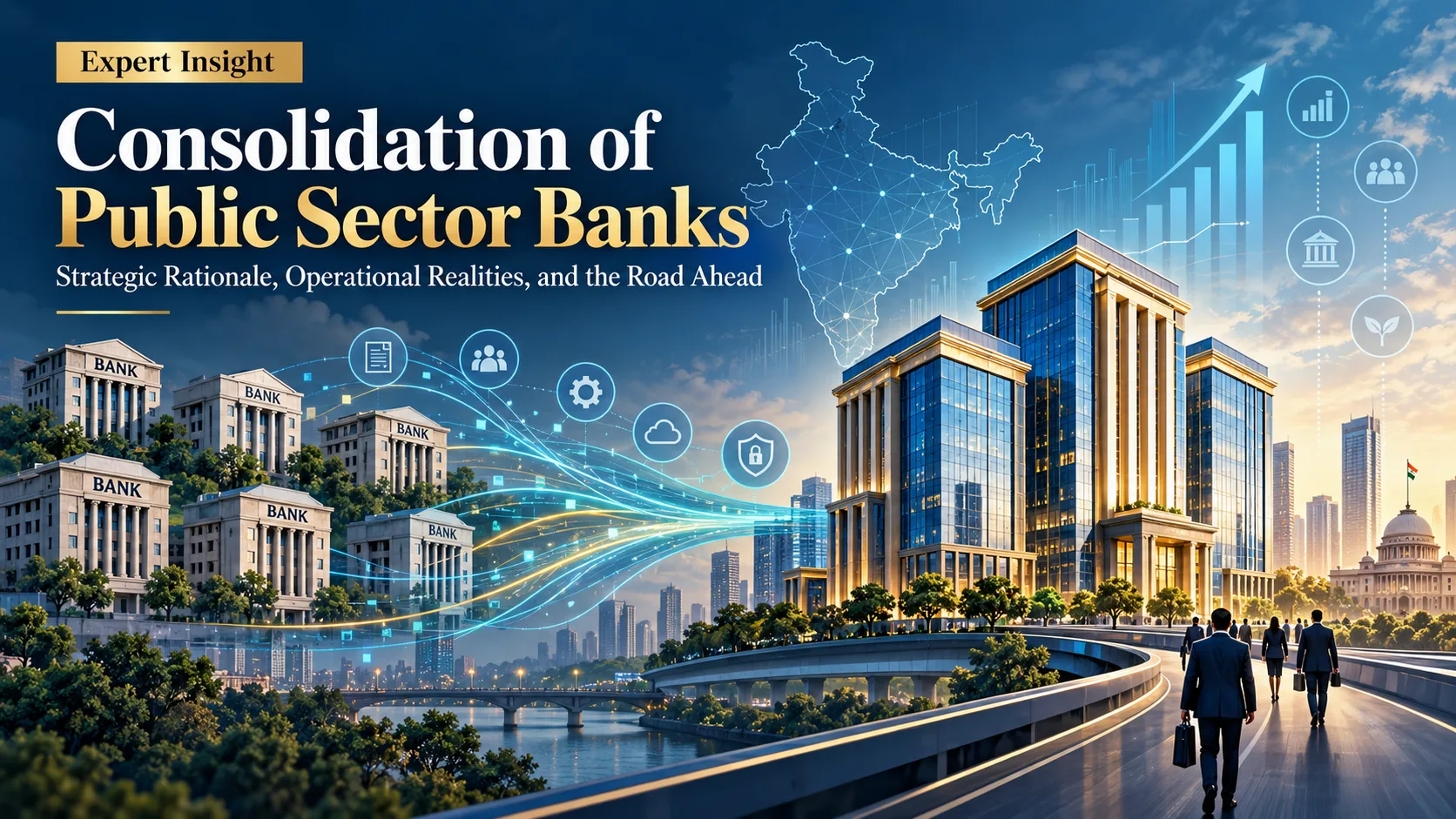
The landscape of Indian public sector banking has undergone a structural transformation over the past decade. From 27 Public Sector Banks (PSBs) in 2017 to 12 consolidated institutions today, the amalgamation drive represents the most ambitious banking sector reform since nationalisation in 1969 and 1980.
While the headline rationale centered on creating global-scale lending power and rationalising capital allocation, banking consolidation carries operational, technological, and governance challenges. This analysis evaluates why these mergers took place, their measurable impact on balance sheets, and what financial institutions must navigate next.
1. The Strategic Catalyst: Why Merge Nationalised Banks?
For decades, the Indian banking system suffered from structural fragmentation: multiple mid-tier public sector lenders competed for the same retail deposits and corporate exposures within overlapping geographies, often saddled with elevated Non-Performing Assets (NPAs).
Consolidation Roadmap at a Glance:
2017: State Bank of India absorbs 5 associate banks + Bharatiya Mahila Bank
2019: Bank of Baroda anchors Dena Bank and Vijaya Bank
2020: 10 PSBs consolidated into 4 anchor institutions:
Punjab National Bank (amalgamated with Oriental Bank of Commerce and United Bank of India)
Canara Bank (amalgamated with Syndicate Bank)
Union Bank of India (amalgamated with Andhra Bank and Corporation Bank)
Indian Bank (amalgamated with Allahabad Bank)
(The remaining 6 standalone PSBs: Bank of India, Central Bank of India, Indian Overseas Bank, UCO Bank, Bank of Maharashtra, and Punjab & Sind Bank).
The strategic goals behind this consolidation were driven by three core priorities:
Scale and Capital Efficiency: Large-scale infrastructure projects require single-borrower lending limits that fragmented mid-tier banks could not underwrite without syndicate friction. A consolidated balance sheet absorbs shock capital, deploys larger credit tickets, and meets Basel III capital adequacy buffers without requiring chronic recapitalisation from government coffers.
Rationalisation of Operating Costs: Operating identical physical infrastructure across tier-1 and tier-2 corridors generated substantial cost-to-income penalties. Consolidating redundant branches and back-office operations freed up capacity for technology capital expenditure.
Harmonisation of Risk Governance: Disparate credit appraisal processes and varying underwriting standards across smaller banks contributed to previous NPA build-ups. Consolidation established standardized underwriting frameworks under the EASE (Enhanced Access and Service Excellence) reform agenda.
2. Structural Metrics: Pre-Merger vs. Post-Consolidation
Comparing baseline metrics across both eras highlights the shift in banking fundamentals:
Institution Footprint
Pre-Consolidation: 27 fragmented public sector entities operating independently.
Post-Consolidation: 12 unified anchor entities.
Strategic Implication: Dramatically streamlined regulatory supervision, compliance reporting, and systemic risk monitoring by the Reserve Bank of India.
Balance Sheet & Credit Capacity
Pre-Consolidation: A fragmented ecosystem of small and regional balance sheets with limited individual underwriting capacity.
Post-Consolidation: Multi-lakh crore asset bases across anchor banks.
Strategic Implication: Creates institutions capable of underwriting national infrastructure projects, funding corporate expansion, and absorbing asset-side cyclical shocks.
Asset Quality & Provisioning
Pre-Consolidation: Chronic double-digit Gross NPAs (often exceeding 10% to 14% across multiple lenders).
Post-Consolidation: Gross NPAs brought down below 4%, backed by Provision Coverage Ratios (PCR) exceeding 80%.
Strategic Implication: Healthier recovery pipelines, faster bad debt resolutions, and a structurally cleaner start to new credit cycles.
Technology Infrastructure
Pre-Consolidation: Siloed CBS versions, duplicate maintenance contracts, and disjointed software vendor architectures.
Post-Consolidation: Unified enterprise cores (predominantly Finacle and TCS BaNCS platforms) operating on shared digital rails.
Strategic Implication: Substantial reduction in technology licensing overhead, standard APIs for fintech integrations, and consolidated cybersecurity architecture.
Cost-to-Income Dynamics
Pre-Consolidation: Elevated ratios (consistently 52% to 55%+) driven by overlapping branch footprints and duplicated back-office operations.
Post-Consolidation: Operating ratios trending below 48% across top performers.
Strategic Implication: Realization of operational leverage, stronger net interest margins, and higher retained earnings to fund ongoing expansion.
3. The Core Operational Challenges
While financial ratios have demonstrated clear recovery post-merger, the friction of mega-mergers manifests across three operational vectors:
A. Core Banking Solution (CBS) Integration
Merging account ledgers, customer IDs, and database dictionaries between disparate CBS platforms remains the single largest operational hurdle. IFSC updates, automated clearing mandates, and standing instruction transfers often produce transient customer friction if cutover protocols are not rigorously tested in sandbox environments.
B. Cultural and Seniority Synthesis
Integrating tens of thousands of employees requires reconciling differing promotion criteria, seniority rosters, and union alignments. Cultural differences—such as regional work practices versus centralised reporting models—typically take several financial cycles to synthesize into a unified corporate identity.
C. Rationalisation of Urban vs. Rural Networks
Branch rationalisation is relatively simple in metro centers where two merged branches exist within hundreds of meters of each other. However, in semi-urban and rural corridors, closing or re-routing branches risks diluting local financial inclusion commitments. Anchor institutions have had to carefully balance branch efficiency with rural priority-sector mandates.
4. The Horizon: Next-Phase Reforms
The 12-bank architecture has stabilized the public sector banking system, but structural consolidation is not the final destination. The next chapter of value creation requires:
Board Governance Autonomy: Transitioning PSBs toward greater corporate autonomy, granting independent boards leeway in executive recruitment, performance-linked compensation, and digital capital allocation.
Digital-First Transformation: Expanding beyond branch operations into automated digital origination, end-to-end data analytics, and paperless retail and MSME credit underwriting to match private sector speed.
Disciplined Credit Risk Monitoring: Ensuring that enlarged balance sheets maintain robust early-warning systems, preventing the single-sector concentration risks that characterized previous corporate lending cycles.
Consolidation solved the balance-sheet fragmentation that constrained Indian banking for decades. The mandate now is converting scale into operational agility—ensuring anchor public sector institutions deploy capital prudently while building enduring technological muscle.