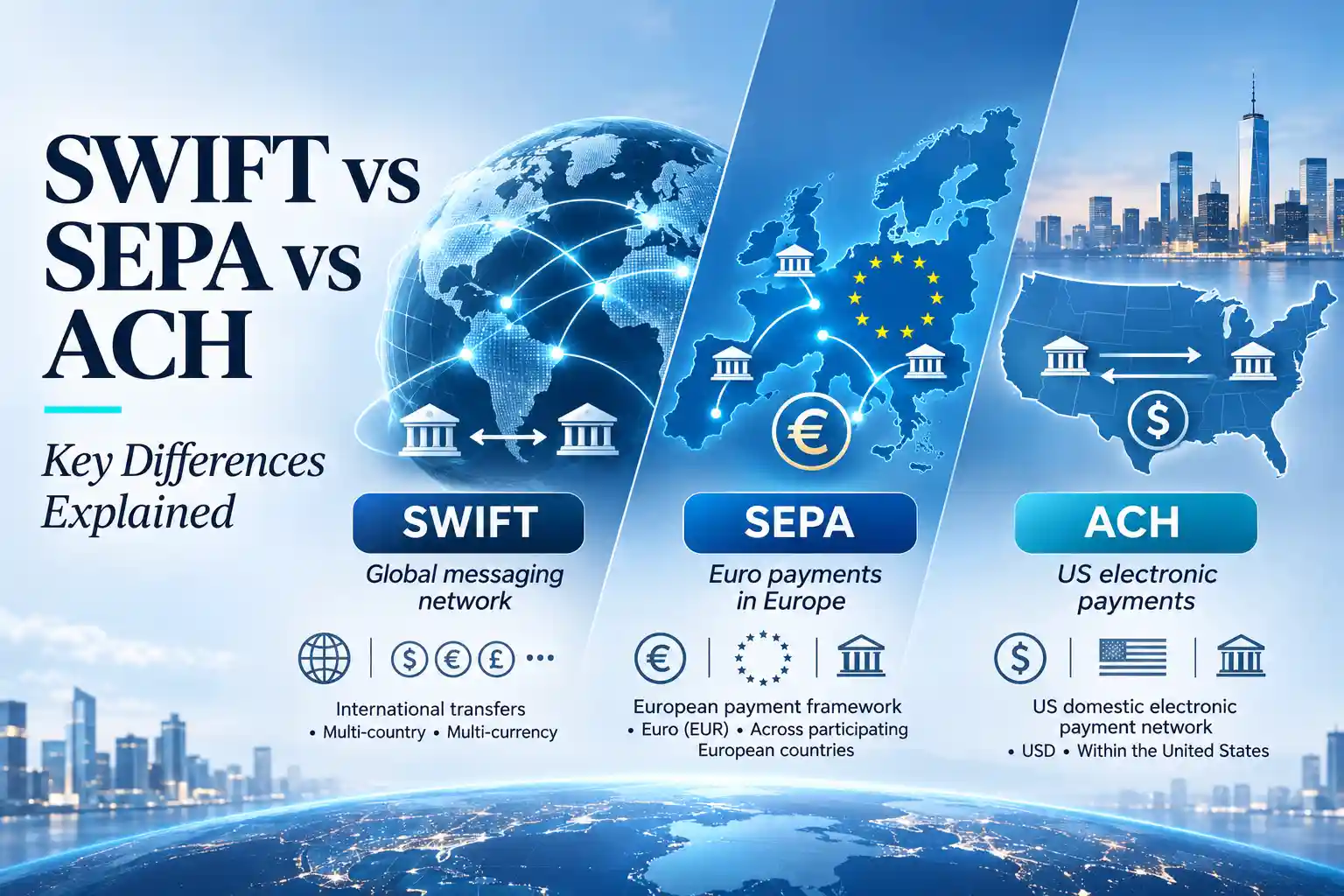
International and domestic bank transfers rely on different financial networks and payment arrangements. Three frequently encountered names are SWIFT, SEPA, and ACH.
Although all three are associated with electronic payments, they do not perform identical functions. SWIFT primarily provides secure financial messaging, SEPA standardizes euro payments across participating European countries, and ACH is a US electronic funds transfer network.
This BankingTrail guide explains how each works, where it is used, how long payments typically take, and which option may be appropriate for different situations.
SWIFT vs SEPA vs ACH: Comparison Table
| Feature | SWIFT | SEPA | ACH |
|---|---|---|---|
| Full name | Society for Worldwide Interbank Financial Telecommunication | Single Euro Payments Area | Automated Clearing House |
| Main function | Financial messaging | Euro payment schemes | Electronic payment clearing and settlement |
| Geographic scope | Global | Participating European countries and territories | Primarily United States |
| Currency | Multiple currencies | Euro | Primarily US dollar |
| Typical payment speed | Varies by bank and payment route | Standard: generally up to 1 banking business day; Instant: within 10 seconds | Same day or typically 1–2 banking days |
| International payments | Widely used | Yes, within the SEPA region | Certain cross-border ACH arrangements exist |
| Direct debit support | Messaging can support payment processes | Yes | Yes |
| Common uses | International transfers, interbank instructions | Euro transfers, European bills and salaries | Payroll, bills, account transfers |
| Cost | Provider-dependent; can be relatively high | Often low | Usually low |
The most important distinction is that SWIFT is not itself a money-settlement system, making a direct speed or cost comparison imperfect. Payment timing and charges depend on the actual banking services used.
What Is SWIFT?
SWIFT stands for the Society for Worldwide Interbank Financial Telecommunication. It is a member-owned cooperative that provides a secure and standardized communication network for financial institutions worldwide.
SWIFT plays a major role in international banking by enabling banks to exchange financial messages reliably.
However, SWIFT does not directly hold customer money or settle ordinary bank transfers. It transmits payment instructions, while banks and settlement systems carry out the financial transactions.
How Does a SWIFT Transfer Work?
Consider a customer in Canada who wants to send USD 10,000 to a supplier in Japan.
A simplified transaction may involve:
- The customer instructs their Canadian bank to make an international payment.
- The sending bank verifies the payment information and carries out required compliance checks.
- The bank sends a financial message through SWIFT to the receiving bank or relevant intermediary institution.
- The banks arrange settlement through their accounts and payment relationships.
- The Japanese beneficiary's bank credits the recipient's account after completing its checks.
Depending on the currency, banking relationships and destination, additional intermediary banks may participate.
This is why SWIFT messaging and correspondent banking are closely connected but are not the same thing.
How Long Does a SWIFT Transfer Take?
There is no single processing time for every SWIFT-related international transfer.
The SWIFT message may reach the destination bank quickly, while the actual payment can take longer because of:
- Intermediary banking arrangements
- Compliance and sanctions screening
- Currency conversion
- Bank processing hours and local holidays
- Beneficiary verification and settlement procedures
Many customer-facing international transfers are completed within one to several business days, but some are significantly faster and others may require additional processing.
It would therefore be misleading to claim that every SWIFT transfer takes three to five days.
What Does a SWIFT Transfer Cost?
Customers may encounter sending-bank charges, intermediary-bank deductions, receiving-bank fees and foreign exchange margins.
For example, a hypothetical USD 2,000 transfer could involve:
| Charge | Illustrative amount |
|---|---|
| Sending-bank fee | $15 |
| Intermediary-bank charge | $10 |
| Receiving-bank charge | $5 |
| Total stated bank charges | $30 |
These amounts are hypothetical, not current market prices. Actual costs depend on the provider, currency, route and fee-sharing arrangement. Currency-conversion costs may be additional.
Advantages and Limitations of SWIFT
SWIFT offers global connectivity, standardized communication, strong network security and support for complex international banking relationships.
However, a payment initiated through a SWIFT-connected bank may still involve multiple intermediaries, varying charges and differing settlement times.
SWIFT should be understood as the communication infrastructure supporting a payment, rather than as a single consumer transfer product with one universal price or delivery time.
What Is SEPA?
SEPA stands for the Single Euro Payments Area.
It is a European initiative that harmonizes electronic euro payments across participating countries.
Before SEPA, domestic and cross-border euro payments could involve different standards and procedures.
SEPA introduced common rules and payment schemes, making it easier for individuals and businesses to transfer euros between participating financial institutions.
Importantly, the SEPA region extends beyond the eurozone and European Union.
Participation in SEPA does not necessarily mean that a country uses the euro as its national currency.
How Does a SEPA Transfer Work?
Suppose a customer in France needs to send €800 to a supplier in Germany.
The customer initiates a euro credit transfer using the beneficiary's account information, generally including an IBAN.
The payment service providers process the transfer according to the applicable SEPA scheme.
Because both institutions participate in the SEPA framework, the payment follows harmonized standards.
This can make the transfer relatively straightforward, much like a domestic electronic bank transfer.
Types of SEPA Payments
1. SEPA Credit Transfer (SCT)
A standard euro credit transfer initiated by the payer.
It is commonly used for personal transfers, invoices, salaries and other payments.
Under the standard scheme, execution generally takes up to one banking business day, subject to applicable processing rules and cut-off times.
2. SEPA Instant Credit Transfer (SCT Inst)
An instant euro transfer designed to make money available in the beneficiary's account within 10 seconds.
The scheme supports 24-hour operation, including weekends and public holidays.
Availability depends on whether the relevant payment service providers are covered by applicable requirements and participate in the service.
3. SEPA Direct Debit (SDD)
A payment arrangement that allows an organization to collect euros from a customer's account using an appropriate mandate.
SEPA Direct Debit is commonly used for recurring payments such as utilities, subscriptions and other authorized collections.
Separate Core and B2B direct debit schemes have different rules and protections.
How Much Does a SEPA Transfer Cost?
SEPA transactions are often less expensive than many traditional international wire transfers.
However, a SEPA payment is not automatically free.
Charges vary by account provider, customer type, country and payment service.
Within the European Union, relevant regulations also govern charges for certain cross-border euro payments and instant credit transfers.
For applicable providers, EU instant payment rules prohibit charging more for a corresponding instant euro credit transfer than for a comparable standard credit transfer.
SEPA Developments in 2026
The European Union has introduced requirements to expand instant euro payments.
For many banks and other covered payment service providers in euro-area countries, important deadlines for receiving and sending instant euro transfers took effect during 2025.
Further implementation deadlines apply to certain non-euro-area providers and other categories of payment institutions in 2027.
These developments strengthen the availability of instant euro transfers but should not be interpreted as universal instant-payment access across every SEPA territory.
What Is ACH?
ACH stands for Automated Clearing House.
The ACH Network is a major electronic payment system in the United States. It supports payments between bank and credit union accounts, including consumer, business and government transactions.
ACH is widely used for ordinary financial activities that people may not even recognize as ACH payments.
Examples include:
- Employer salary deposits
- Social Security and other government payments
- Mortgage and utility payments
- Transfers between US bank accounts
- Business-to-business payments
- Authorized recurring subscriptions
ACH supports both credit and debit transactions.
ACH Credit vs ACH Debit
ACH Credit
The payer initiates a payment that pushes funds to the recipient's account.
For example, an employer deposits an employee's salary using ACH Direct Deposit.
ACH Debit
The payee initiates an authorized collection from the payer's account.
For example, a utility company collects a monthly bill using an ACH debit authorized by the customer.
This distinction is important because the payment authorization, return rules and fraud risks differ.
How Does ACH Work?
Consider a US employer paying an employee $3,000 in salary.
- The employer sends payroll instructions through its bank or payroll service provider.
- The originating bank submits the ACH payment information.
- An ACH operator processes the payment information and routes it toward the receiving bank.
- Settlement occurs according to the applicable ACH schedule.
- The receiving bank makes the funds available to the employee in accordance with the relevant rules.
The process is designed to handle large volumes of electronic transactions efficiently.
How Long Does an ACH Payment Take?
ACH payments can settle on the same banking day or according to standard settlement schedules.
Standard ACH credits generally settle within one or two banking days, with many settling by the next banking day.
Same Day ACH allows eligible transactions to settle within the same banking day when required submission deadlines are met.
As of November 2026, the Same Day ACH per-payment limit is $1 million.
ACH settlement does not ordinarily operate on weekends and US federal holidays.
A crucial distinction is that payment settlement and the time funds become available to customers are not always identical.
How Much Does ACH Cost?
ACH is generally a cost-efficient payment method, particularly for recurring payments and high-volume transactions.
Many US banks offer certain ACH transfers without a separate consumer fee.
Businesses and payment processors may charge based on transaction volume, account arrangements or service features.
Consequently, it is more accurate to describe ACH as generally low-cost than to claim it is always free.
SWIFT vs SEPA vs ACH: Which Is Faster?
Payment speed is one of the most common sources of confusion.
SWIFT: The speed of financial messaging does not establish how quickly the beneficiary receives money. Actual completion depends on the banks and settlement arrangements.
SEPA: Standard credit transfers generally operate on a banking-business-day timescale. Eligible SEPA Instant payments are designed to complete within 10 seconds.
ACH: Same Day ACH supports same-banking-day settlement for eligible transfers. Standard ACH payments generally settle within one or two banking days.
For an eligible euro payment between participating providers, SEPA Instant can provide a faster experience than standard ACH settlement.
However, it would be incorrect to conclude that all SEPA payments are faster than all SWIFT-related transfers.
Which Payment Method Is Cheapest?
There is no universally cheapest option for every transaction.
For a typical domestic US bank-to-bank payment, ACH is often an economical choice.
For a euro transfer between participating SEPA payment providers, SEPA credit transfers are usually practical and competitively priced.
For a payment between banks in different countries and currencies, SWIFT messaging may be used as part of the underlying international payment route.
When comparing services, customers should consider the total cost of the transfer, including:
- Upfront transfer fees
- Intermediary or receiving-bank charges
- Foreign exchange rate margins
- The amount the beneficiary ultimately receives
- Expected delivery time
- Any applicable transfer limits
A service advertising a zero transfer fee may still earn revenue through its exchange rate.
Example: Comparing Total Payment Costs
Imagine two providers offering a hypothetical international transfer.
| Factor | Provider A | Provider B |
|---|---|---|
| Advertised transfer fee | $0 | $8 |
| Currency-conversion margin | $25 equivalent | $5 equivalent |
| Total illustrative cost | $25 | $13 |
Although Provider A advertises no transfer fee, Provider B is cheaper in this example.
The figures are illustrative only and do not represent actual provider pricing.
Can SWIFT, SEPA and ACH Work Together?
Yes. They operate at different layers of financial infrastructure and are not always mutually exclusive.
For example, an international payment originating outside Europe may use SWIFT messaging between banks, while its final euro-denominated leg is completed through a SEPA payment arrangement when supported.
Similarly, a cross-border payment service may involve international messaging or correspondent banking infrastructure before delivering funds through a domestic US payment rail.
However, an international transfer does not automatically qualify as a SEPA or ACH payment simply because the receiving bank is in Europe or the United States.
Eligibility depends on the participating institutions, currencies, payment schemes and service arrangements.
SWIFT vs SEPA vs ACH: Real-World Examples
Example 1: A Business in Germany Pays a Supplier in Spain
A German company needs to pay €4,500 to a Spanish supplier.
If both payment service providers support the relevant SEPA service, a SEPA credit transfer is a natural option.
The company may also be able to use SEPA Instant, depending on eligibility and account arrangements.
Suitable arrangement: SEPA.
Example 2: An Employer in the United States Pays Employees
A US company pays its employees in dollars through their domestic bank accounts.
ACH Direct Deposit is widely used for this purpose.
It supports scheduled payments and efficient processing of payroll transactions.
Suitable arrangement: ACH.
Example 3: A Canadian Company Pays a Supplier in Japan
A Canadian importer needs to pay a Japanese supplier in yen.
The payment may require foreign exchange conversion and banking arrangements between institutions in different countries.
Banks may exchange payment instructions through SWIFT, with settlement occurring through appropriate banking relationships.
Possible arrangement: SWIFT messaging with international banking and settlement services.
Example 4: A Customer in France Sends Money to a US Account
The customer wants to send money from a French euro account to a beneficiary's US dollar account.
A normal SEPA transfer is not sufficient to directly deliver US dollars into the beneficiary's US bank account.
The payment provider must support the necessary international transfer, foreign exchange and destination-bank arrangements.
SWIFT messaging may form part of that process, or the provider may use a different cross-border payment infrastructure.
Suitable arrangement: An international payment service that supports EUR-to-USD transfers.
Security: Is SWIFT, SEPA or ACH Safer?
All three operate within established financial environments, but their risks and protections differ.
SWIFT provides secure financial messaging. Its security features do not eliminate fraud or processing risks at participating institutions.
SEPA payments operate under standardized scheme rules and relevant legal requirements. Customer protections depend on the payment type, jurisdiction and circumstances.
ACH operates under Nacha rules and applicable US legal frameworks, including requirements addressing authorization, returns and certain consumer protections.
The risks also differ by transaction type.
For example, an unauthorized ACH debit is not the same as a customer being tricked into authorizing a transfer.
Likewise, the possibility of recalling or reversing an international payment depends on the payment method and circumstances, rather than a universal promise of reversibility.
Customers should verify beneficiary details, protect authentication credentials, and confirm unusual payment requests through trusted communication channels.
The Future of Cross-Border Payments
Payment infrastructure is evolving as governments, central banks and financial institutions seek faster, more transparent and less expensive transactions.
Several developments are particularly relevant.
ISO 20022 messaging: Structured financial data can improve the consistency and usefulness of payment information.
Instant payment infrastructure: Faster domestic and regional payment systems are expanding, including instant euro transfers and US instant-payment services.
Payment system interoperability: Financial authorities are exploring ways to connect payment networks across borders.
Improved payment transparency: Banks and payment providers are working to provide clearer information about transfer status, charges and delivery.
New settlement technologies: Tokenization and other innovations are being explored as possible improvements to financial infrastructure.
These developments may increase competition and improve customer experiences.
They do not, however, eliminate all challenges associated with currency conversion, regulatory compliance, liquidity and international settlement.
Frequently Asked Questions
Is SWIFT the same as an international wire transfer?
No. SWIFT is a financial messaging network. Banks may use SWIFT messages to arrange international wire transfers, but the actual funds are transferred through banking accounts and settlement arrangements.
Can SEPA transfer money outside Europe?
SEPA payments are designed for euro transfers between eligible payment service providers within the SEPA geographic area. A separate international payment arrangement is normally required for destinations outside that area.
Can ACH be used internationally?
ACH is primarily a US payment network, but international ACH transaction arrangements exist. Availability depends on financial institutions, corridors and applicable rules.
Is SEPA faster than SWIFT?
SEPA Instant is designed to make funds available within 10 seconds. SWIFT, however, is a messaging network rather than a settlement method, so actual international payment times depend on the underlying arrangements.
Is ACH the same as a wire transfer?
No. ACH and wire transfers use different payment infrastructure, processing methods and rules. ACH is often used for recurring and lower-cost US payments, while wire transfers may be preferred for certain urgent or higher-value transactions.
Do SWIFT and SEPA use IBAN?
IBAN is commonly used to identify payment accounts in SEPA transfers. IBANs can also be used in international payments involving SWIFT, where applicable. Required account identifiers vary by destination country and payment provider.
Are ACH payments instant?
Ordinary ACH payments are not instant. Same Day ACH supports settlement within the same banking day for eligible payments, subject to processing deadlines.
Which is best for international businesses?
The appropriate payment method depends on the payment corridor, currencies, beneficiary location, transaction value, speed requirements and available providers. Businesses should compare total costs and operational requirements rather than choosing solely by network name.
Conclusion
SWIFT, SEPA and ACH are fundamental parts of modern banking, but each serves a different purpose.
SWIFT connects financial institutions through standardized messaging. SEPA harmonizes euro payments across participating European markets. ACH enables efficient electronic payments through the US banking system.
Understanding these distinctions helps consumers and businesses make better-informed payment decisions.
For domestic US transfers, ACH may offer an economical solution. For eligible euro payments in Europe, SEPA provides standardized and increasingly instant options. For payments crossing more currencies and banking systems, international transfer services supported by SWIFT messaging and correspondent banking remain important.
Rather than asking which network is universally best, customers should consider which available payment arrangement offers the appropriate combination of speed, cost, coverage and reliability.
References and Further Reading
- SWIFT — What Is SWIFT?
https://www.swift.com/about-us/who-we-are/what-swift - European Central Bank — Single Euro Payments Area
https://www.ecb.europa.eu/paym/retail/sepa/html/index.en.html - European Central Bank — Instant Payments Regulation
https://www.ecb.europa.eu/paym/retail/instant_payments/html/instant_payments_regulation.en.html - Nacha — How ACH Payments Work
https://www.nacha.org/content/how-ach-payments-work - Nacha — ACH Payments Fact Sheet
https://www.nacha.org/content/ach-payments-fact-sheet - Nacha — The ABCs of ACH
https://www.nacha.org/content/abcs-ach
Disclaimer: This article provides general financial education and does not constitute individualized financial advice. Payment availability, fees, timelines, limits and customer protections vary by institution, jurisdiction and transaction type.